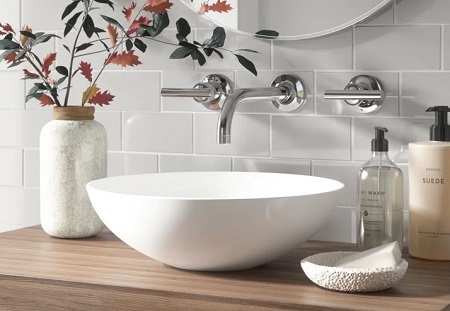
Vessel sinks, which are bowl-shaped basins that sit on top of the counter, are a popular choice for modern bathrooms. They look great because of their sculptural shape and added height, but they also make the technical side more challenging. This article looks at how vessel sinks and common countertop installations work together in real-life projects. It also helps designers, specifiers, and DIYers choose the best combination of sink, faucet, and countertop.
Sink types and countertop styles (quick overview)
- Vessel sink: It sits on the countertop and needs taller spouts, deck-mounted tall faucets, or wall-mounted taps. The countertop must be strong enough to support the sink rim and allow for the required plumbing cutouts.
- Undermount sink: The sink and countertop are made from one solid piece of material, such as solid surface or resin. The faucet options depend on whether the holes are already drilled or whether the faucet will be mounted on the wall.
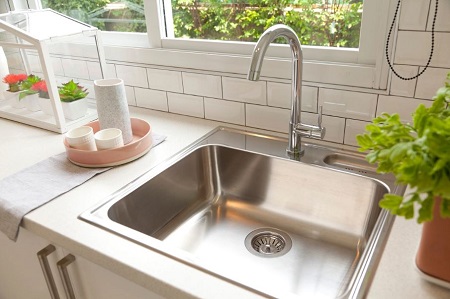
- Drop-in (self-rimming) sink: It sits in a cutout with the rim resting on top of the counter. You can use standard deck-mounted faucets with this setup.
- Integrated or solid-surface sinks: The sink and countertop are made from one solid piece of material, such as solid surface or resin. The faucet options depend on whether the holes are already drilled or whether the faucet will be installed on the wall.
Faucet mounting options — which work best with vessels?
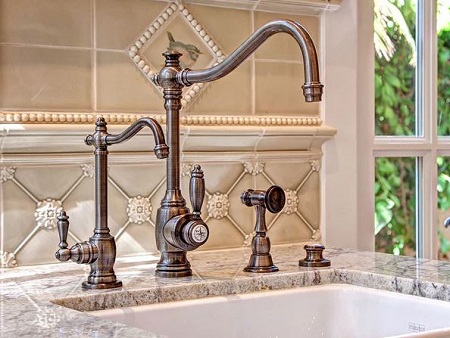
- Tall vessel faucets (single-hole, deck-mounted) — These are great for boat sinks. The water lands closer to the drain instead of splashing on the rim because they have higher spouts and a longer reach. When choosing one, make sure to check the spout height (from the top to the base) and the spout reach (from centerline to centerline).
- Deck-mounted widespread and centerset faucets — Use vessel sinks that are less common, such as drop-in or undermount styles. Most vessel bowls are too tall for standard widespread faucet sets unless the countertop is recessed or the sink rim sits low.
- Wall-mounted faucets — Very compatible. They free up space on the deck and work well in places where the countertop is thin or made from a material that is difficult to drill. The spout height above the sink rim and the spout reach are both extremely important.
- Centerset and standard bathroom faucets — They are not ideal for standard vessel bowls because the spout height is usually too low.
Countertop considerations
- Thickness and structural support: The rim of a vessel sink transfers its weight to the countertop. Natural stone, quartz, or well-supported plywood are the best materials. Thin countertops (less than 12 mm) may need additional support or backing to prevent cracking around the sink cutout.
- Hole placement and tap clearance: There must be enough space behind or beside the bowl to place vessel faucets. For tall deck-mounted faucets, make sure there is room for the faucet base, the handles, and access to the supply connections. Also consider how far the water will fall into the bowl.
- Cutout edge finishing: The edges of vessel sink cutouts should be smooth and properly sealed. If the countertop material is porous, such as wood or laminate, seal the cutout thoroughly to prevent moisture from getting in.
- Mounting surface: Some vessel sinks, especially those made of stone or thick ceramic, can be quite heavy. Make sure the cabinet and countertop can support the combined weight of the sink and the water, and use the appropriate adhesive or fasteners as specified by the manufacturer.
Plumbing and code issues
- Trap and drain alignment: Make sure the pop-up or grid strainer aligns with the waste and trap, since vessel sinks often have deeper bowls. If you are using hidden trap adapters or wall-outlet drains, confirm that there is enough vertical clearance inside the vanity.
- Overflow requirements: Some vessel sinks do not have overflows. This may be acceptable in some applications, but hotel standards or local building codes may require them. Always check your local plumbing code and consider how the space will be used.
- Backflow and venting: Standard plumbing rules still apply; installing a vessel sink does not change the venting requirements. However, deeper basins may require careful trap configuration to maintain proper drainage and prevent siphoning.
Installation tips & dimensional checks
- Measure twice: The key things to check are the spout height, the spout reach, and the space between the sink rim and the countertop. As a guideline, the tip of the spout should be about 4 to 6 inches (100 to 150 mm) above the sink rim to provide enough clearance and reduce splashing.
- Template use: Manufacturers’ cutout and hole templates are very important. When remodeling, always dry-fit the sink and faucet before making the final cut and sealing everything in place.
- Protect the countertop: To prevent stains and leaks, apply a non-acidic sealant between the sink rim and the countertop.
- Access panels: Make sure the vanity design allows access to the valves for service, especially if you are using wall-mounted faucets or hidden supply shutoffs.
Aesthetic and functional trade-offs
- Height vs ergonomics: A very tall faucet or vessel sink can look impressive, but it may not be comfortable for users who are much taller or shorter. When designing public or family bathrooms, consider the average user to ensure the setup is practical as well as attractive.
- Counter space: Vessel sinks take up more visible and usable space on the countertop. Choose faucets that leave enough room around the sink for soap dispensers and other personal items.
- Material matching: To avoid staining and to make cleaning easier, choose metal finishes, ceramic glazes, and stone tones carefully. For example, avoid using soft metal finishes near rough stone edges.
Quick spec checklist (practical)
- Confirm countertop thickness & reinforcement needs.
- Verify sink weight and rim diameter; plan load support.
- Specify faucet type by sink: tall vessel faucet or wall-mount preferred.
- Verify spout height (mm) and reach (mm); ensure 100–150 mm clearance above rim recommended.
- Plan drain assembly and trap location; allow for deeper bowl.
- Check local plumbing codes for overflow requirements and accessibility.
- Use manufacturer templates and follow their torque and sealing instructions.
Visual aids
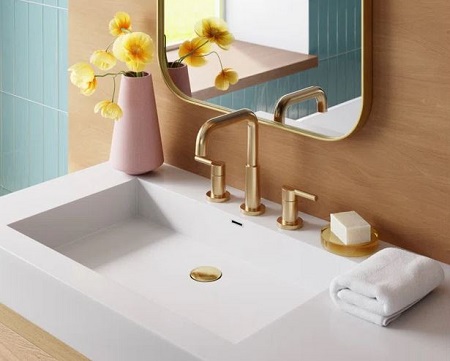
- The image above is an example created with DALL·E that shows a vessel sink, different types of faucets, and measurement markers. It makes it easy to see how the countertop layout, spout height, and faucet reach all relate to each other.
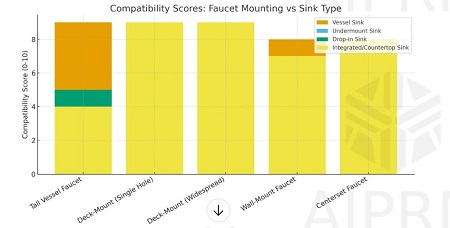
- A compatibility chart is included showing relative scores for common faucet vs sink-type combinations (tall vessel faucets score highest for vessel sinks; undermount sinks pair best with standard deck-mounted faucets). The chart and underlying table are shown so you can compare options at a glance.