Commercial Restroom Queue Calculator: How Long Will Users Wait for Sinks, Touchless Faucets & Soap During Peak Traffic?
A commercial restroom can have many sinks and still develop a line when users arrive faster than the handwashing stations can process them. Stadium halftime, airport arrival banks, theater intermissions, convention breaks and university class changes can produce short periods when sink demand exceeds available throughput. This guide provides a practical queue-planning model for estimating sink-bank capacity, queue growth, approximate clearing time, fixture-outage impact and the benefit of adding additional touchless handwashing positions.
A Restroom Queue Starts When Arrivals Exceed Throughput
Users Arriving per Minute − Users Served per Minute
If the result is positive, the line grows.
If capacity exceeds arrivals, the restroom can process incoming users while also reducing an existing queue.
How Many Users Can One Sink Process?
60 ÷ Average Sink Occupancy in Seconds
| Average Sink Occupancy | Theoretical Throughput / Sink / Minute |
|---|---|
| 20 seconds | 3.0 users/minute |
| 30 seconds | 2.0 users/minute |
| 40 seconds | 1.5 users/minute |
| 45 seconds | 1.33 users/minute |
| 60 seconds | 1.0 user/minute |
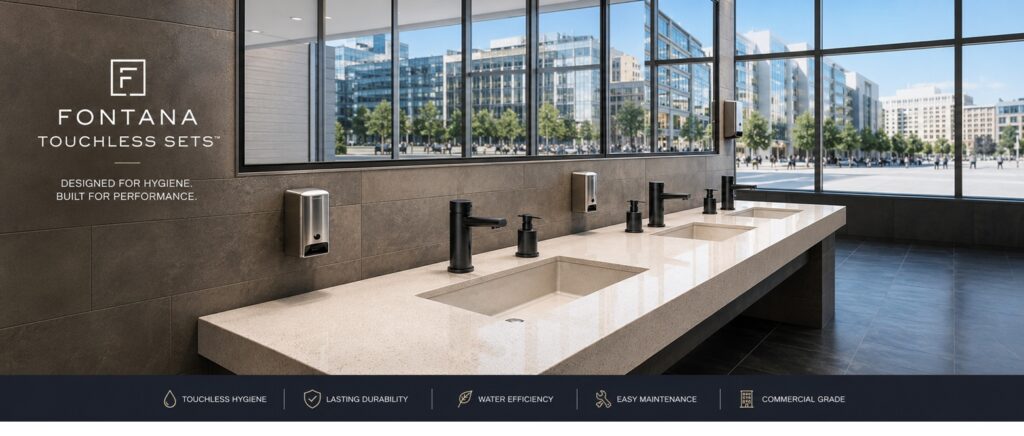
Interactive Commercial Restroom Queue Calculator
This calculator estimates deterministic queue growth during a peak interval. It is intended for preliminary planning, not formal stochastic queuing simulation.
*Clear time assumes peak arrivals end and the operational sink bank continues processing the remaining queue.
10 vs 20 vs 30 Sinks During the Same Peak
Assume users occupy a sink for an average of 30 seconds.
| Operational Sinks | Theoretical Service Capacity | Incoming Demand | Result |
|---|---|---|---|
| 10 sinks | 20 users/min | 30 users/min | Queue grows by 10 users/min |
| 15 sinks | 30 users/min | 30 users/min | System operates at theoretical saturation |
| 20 sinks | 40 users/min | 30 users/min | 10 users/min of theoretical spare capacity |
| 30 sinks | 60 users/min | 30 users/min | Large theoretical reserve |
How Fast Can a Queue Grow?
Assume:
- 20 operational sinks
- 30-second average sink occupancy
- 40-user/minute theoretical capacity
- 50 arrivals/minute for 10 minutes
50 arrivals/min − 40 served/min = 10 users/min
10 users/min × 10 minutes = 100 waiting users
This is why a relatively small mismatch between arrival rate and service capacity becomes visually significant during a stadium or theater intermission.
How Long Does the Queue Take to Clear?
Suppose 100 users remain waiting after a stadium peak ends and the restroom has 20 operational sinks processing two users per minute each.
20 sinks × 2 users/min = 40 users/min
100 waiting users ÷ 40 users/min = 2.5 minutes
That simple calculation assumes new arrivals fall to zero. If people continue arriving, only the capacity remaining after serving new users can reduce the queue.
Queue Clearing With Continuing Arrivals
Assume:
- 40 users/minute total sink capacity
- 20 new users/minute after the peak
- 100 users already waiting
40 capacity − 20 new arrivals = 20 waiting users cleared/minute
100 users ÷ 20/minute = 5 minutes
This is much more realistic than assuming the restroom becomes empty the instant the formal intermission ends.
One Failed Faucet Can Matter More Than It Appears
At a 30-second average occupancy:
| Installed | Offline | Operational | Capacity | Lost Capacity |
|---|---|---|---|---|
| 20 | 0 | 20 | 40 users/min | — |
| 20 | 1 | 19 | 38 users/min | 2 users/min |
| 20 | 2 | 18 | 36 users/min | 4 users/min |
| 20 | 4 | 16 | 32 users/min | 8 users/min |
That illustrates why serviceability, uptime and spare-parts planning matter in high-traffic commercial projects.
Stadium Halftime Queue Example
Assume one restroom bank receives 600 handwashing users over a 12-minute halftime interval.
600 ÷ 12 = 50 users/minute
Assume 30-second average sink occupancy:
| Operational Sinks | Capacity | Difference vs 50 Arrivals/Min | 12-Minute Queue Effect |
|---|---|---|---|
| 15 | 30/min | -20/min | +240 waiting users |
| 20 | 40/min | -10/min | +120 waiting users |
| 25 | 50/min | 0 | Theoretical saturation |
| 30 | 60/min | +10/min reserve | Can absorb some variability |
Fontana’s current commercial high-traffic guidance specifically identifies stadiums, arenas, convention centers, theaters and entertainment facilities as locations where restroom traffic surges before events, during breaks and after programs.
High-Traffic Commercial RestroomsAirport Queue Example
Airport demand may be less explosive than stadium halftime but can last much longer.
Assume:
- 360 users arrive over 15 minutes
- 24 users/minute arrival rate
- 30-second average sink occupancy
| Operational Sinks | Capacity | Planning Observation |
|---|---|---|
| 10 | 20/min | Demand exceeds theoretical capacity. |
| 12 | 24/min | Operates at theoretical saturation. |
| 15 | 30/min | Provides useful theoretical reserve. |
| 18 | 36/min | Greater resilience to irregular arrivals and downtime. |
Fontana’s airport-restroom guidance emphasizes sufficient space for multiple users, accessible layouts, touchless faucets and soap dispensers, adequate supplies and restroom configurations designed for heavy passenger use.
Airport Restroom Design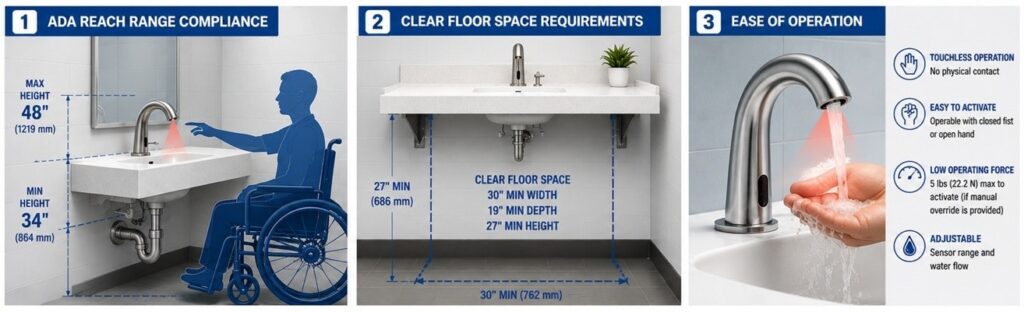
Accessible Lavatories Should Not Be Treated as “Slow Stations”
Accessibility belongs in the restroom design itself rather than being treated as an exception to the queue model.
The U.S. Access Board requires compliant clear floor space, knee/toe clearance and reachable operable parts at accessible lavatories. Soap dispensers provided at accessible lavatories must be within applicable reach ranges and conveniently usable from that position.
Queue planning should therefore preserve accessible stations as full, well-positioned handwashing resources rather than placing them at the least convenient edge of the sink bank.
U.S. Access Board Lavatory GuideSoap Can Become the Queue Before the Sink Does
Imagine a bank of twenty sinks with enough faucet capacity for forty users per minute, but only ten conveniently reachable soap dispensers.
If users must wait, cross-reach or move sideways to obtain soap, the sink bank’s theoretical throughput is no longer the same as its practical throughput.
Touchless Fixture Response Affects Queue Time
If users repeatedly move their hands under a sensor waiting for activation, their station occupancy increases.
Fontana’s current public-facility guidance identifies practical touchless issues such as premature shutoff, sensor false activation, adjacent-fixture cross-activation, nozzle clogging, inconsistent soap volume and maintenance complexity as considerations in demanding public restroom installations.
Touchless Public-Facility Systems
What If Sensor Problems Add Only Five Seconds?
Suppose nominal sink occupancy is 30 seconds but repeated sensor attempts add five seconds.
| Station Time | Users / Sink / Minute | 20-Sink Capacity |
|---|---|---|
| 30 seconds | 2.00 | 40.0 users/min |
| 35 seconds | ≈1.71 | ≈34.3 users/min |
| 40 seconds | 1.50 | 30.0 users/min |
| 45 seconds | ≈1.33 | ≈26.7 users/min |
That is why reliable sensor response is an operational issue, not merely a convenience feature.
What Is the Value of Adding Five More Sinks?
At a 30-second station occupancy:
5 sinks × 2 users/min = 10 additional theoretical users/min
During a 15-minute peak:
10 users/min × 15 minutes = 150 additional user-services
Queue-Reduction ROI Framework
Sinks + Faucets + Soap Dispensers + Plumbing + Electrical + Counter + Installation
Reduced Queue + Faster Peak Recovery + Greater Fixture Redundancy + Improved User Experience
Not every queue benefit can be converted directly into dollars, but airports, stadiums and premium public facilities should still consider user waiting, congestion and service reliability when comparing capital alternatives.
MultiFeed Can Support More Soap Positions Without More Refill Points
One of the useful distinctions in large restroom planning is separating user-facing soap outlets from maintenance-facing soap reservoirs.
This allows a project to protect user throughput without necessarily giving maintenance personnel twenty separate soap bottles to replenish.
Fontana MultiFeed™ Engineering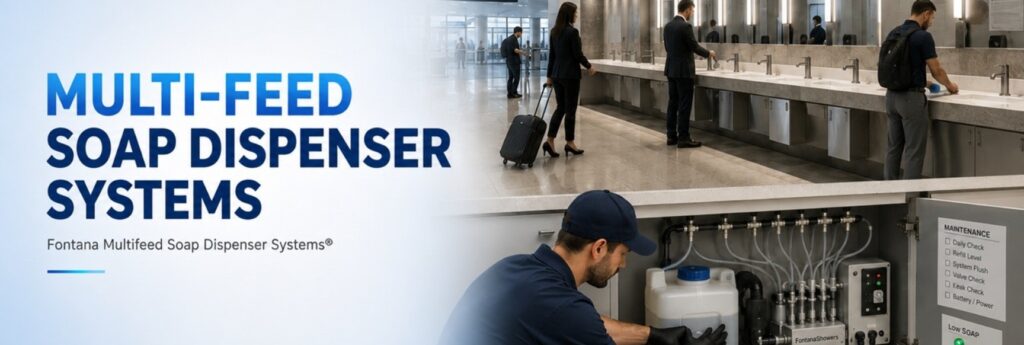
Commercial Restroom Queue Worksheet
| Planning Input | Project Value |
|---|---|
| Facility type | ________________________ |
| Installed sink positions | ________________________ |
| Expected fixtures offline during peak | ________________________ |
| Operational sink positions | ________________________ |
| Average sink occupancy | ________ seconds |
| Theoretical sink-bank capacity | ________ users/min |
| Peak arrival rate | ________ users/min |
| Peak duration | ________ minutes |
| Estimated queue growth rate | ________ users/min |
| Estimated peak queue | ________ users |
| Post-peak arrival rate | ________ users/min |
| Estimated queue-clearing capacity | ________ users/min |
| Estimated queue clear time | ________ minutes |
| Dedicated soap positions | ________________________ |
| Central soap zones | ________________________ |
| Accessible lavatory placement reviewed | YES / NO |
Queue Risk by Facility Type
| Facility | Typical Queue Pattern | Primary Design Response |
|---|---|---|
| Stadium / Arena | Very intense short surge | High simultaneous fixture throughput and redundancy |
| Airport | Long baseline plus irregular flight peaks | High availability, circulation and resilient sink banks |
| Theater | Short intermission surge | Rapid peak processing |
| Convention Center | Session breaks and event transitions | Large distributed restroom capacity |
| University | Class-change and lunch peaks | Predictable scheduled capacity |
| Office Tower | Moderate distributed demand | Balance fixture quantity with floor-level practicality |
| Luxury Hotel / Resort | Guest and event peaks | Capacity without sacrificing premium experience |
Commercial Restroom Throughput & Touchless Resources
Current Fontana guidance for airports, stadiums, schools, hospitals, transportation facilities and other high-use restroom environments.
High-Traffic RestroomsCurrent Fontana guidance addressing passenger flow, multiple users, accessibility, touchless fixtures and restroom servicing.
Airport Restroom GuideTechnical discussion of sensor performance, cross-activation, nozzle clogging, soap output and facility maintenance.
Public-Facility Touchless GuideCentral soap reservoir, pump, manifold and distribution-system planning for large commercial restroom installations.
MultiFeed™ SystemsFontana commercial sensor-faucet collection for public and high-traffic lavatory applications.
Touchless FaucetsCommercial automatic soap dispenser systems for coordinated touchless handwashing stations.
Automatic Soap DispensersIndependent Accessibility Reference
Official guidance on accessible lavatories, clear floor space, reach ranges, soap dispensers, operable parts and touch-free fixtures.
ADA Lavatory GuidanceCommercial Restroom Queue FAQ
How do you calculate restroom sink throughput?
As a simple planning model, divide 60 seconds by average sink occupancy time to estimate theoretical users served per sink per minute, then multiply by the number of operational wash positions.
How does a restroom queue form?
A queue grows when users arrive at the sink bank faster than the operational wash positions can process them.
How many users can a sink serve in one minute?
At a theoretical 30-second occupancy, one sink can process about two users per minute. Actual performance varies with user behavior and facility conditions.
How much capacity do 20 sinks provide?
At a theoretical 30-second occupancy, twenty operational sinks provide about 40 user-services per minute.
What happens if two of twenty faucets fail?
At 30 seconds per user, capacity falls from approximately 40 to 36 users per minute. During a large peak, that loss can materially increase queue growth.
Why do stadium restroom queues grow so quickly?
Halftime and intermission can compress hundreds of restroom users into only a few minutes, causing arrivals to exceed wash-station capacity.
Can automatic soap dispensers create a restroom bottleneck?
Yes. If too few soap positions are provided, dispensers are empty, or users must repeatedly activate them, the soap step can slow the overall handwashing sequence.
Can MultiFeed reduce restroom queues?
MultiFeed does not directly increase sink speed, but it can support many user-facing soap dispensing positions while reducing separate soap-refill locations, helping maintain soap availability during heavy use.
Are touchless faucets useful for accessible restrooms?
The U.S. Access Board notes that motion-activated faucets and dispensers can provide easier access and accommodate a broader range of users.
Is this calculator a formal queuing model?
No. It is a deterministic throughput and queue-accumulation planning model. Complex projects may benefit from formal queuing simulation using measured or forecast arrival distributions and service-time data.
Final Recommendation: Design the Sink Bank for Recovery, Not Just Saturation
A restroom that can theoretically process exactly the expected arrival rate has very little operating resilience.
That means adequate operational sinks, reliable touchless faucets, conveniently positioned automatic soap dispensers, usable reserve capacity and a maintenance strategy that keeps the entire handwashing sequence functioning during the facility’s busiest periods.