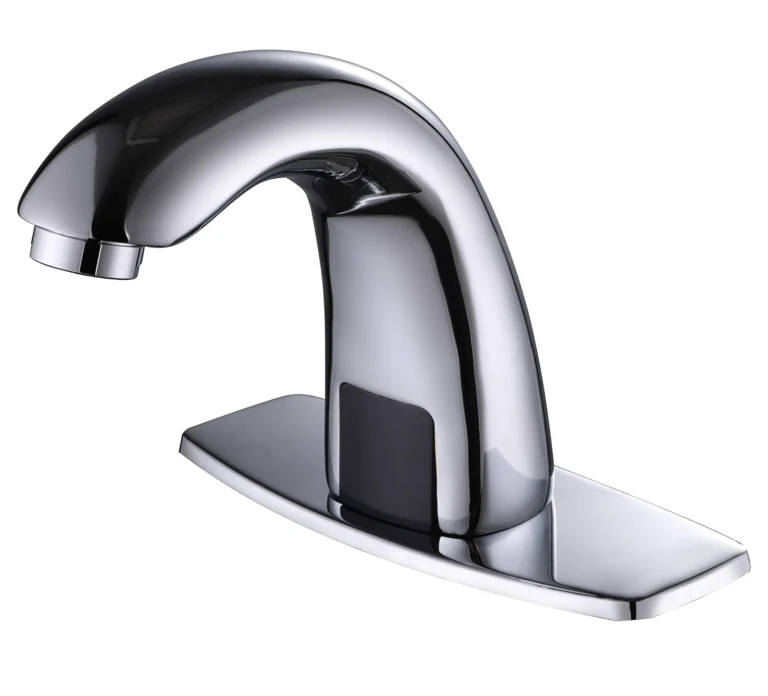

A touchless faucet will fit your existing sink as long as you match two things: the hole count on your basin (or deck) and the sensor’s minimum working distance to the basin’s depth and width. Get either wrong and you end up with a faucet that fires when you walk past the mirror, or one that splashes water past the bowl every time it triggers. Hole configuration and sensor range matter more than any hygiene feature the faucet advertises.
Single-Hole vs 3-Hole Touchless Options
Basin faucets come drilled for one of two common setups. A single-hole faucet has the spout, sensor, and (if there is one) a mechanical temperature control all combined into one body that drops through one hole. A 3-hole setup spreads the spout and two separate handles across three holes, usually on 4-inch or 8-inch centers.
Touchless faucets are built for both configurations, but single-hole units are far more common because the sensor housing and battery compartment need room inside the base. If your sink is currently 3-hole and you want a single-hole touchless faucet, you will cover the two outer holes with a deck plate (more on that below). If you want to keep three separate holes, look specifically for widespread touchless models. They exist, but the selection is smaller and the temperature control is usually a separate mechanical valve wired to the same sensor and solenoid.
Before you shop, measure your current hole spacing center to center and count the holes. Write it down. This single measurement eliminates most of the return-and-reorder headaches with touchless faucets.
Matching Sensor Range to Basin Depth
Touchless faucets trigger using an infrared sensor near the spout tip. Typical sensor range is 4 to 6 inches from the tip, meaning the sensor turns the water on when your hands (or anything else) break that zone. This range is fixed by the manufacturer and usually cannot be adjusted beyond a small tolerance.
Basin depth and width interact with that fixed range in ways people miss. A shallow basin, especially a vessel sink mounted high, can put your hands inside the sensor zone constantly during normal use like brushing teeth or wetting a washcloth, causing phantom triggers. A basin that is too wide relative to spout reach forces you to lean in past the ideal zone, so the faucet either doesn’t trigger reliably or triggers late.
Before buying, check the manufacturer’s spec sheet for sensor range, then measure from where your spout will sit to the bottom of your basin. If that distance is close to or less than the minimum sensor range, expect false triggers.
Spout Reach and Splash Zone Math
Spout reach is the horizontal distance from the base of the faucet to where the water stream lands. On a touchless faucet, this distance also defines your splash zone, since the sensor fires the moment something enters that space, not just when hands are directly under the stream.
The math is simple: water needs to land inside the bowl, with margin, at every point where the sensor might trigger. If your spout reach puts the stream within an inch or two of the basin’s front or back wall, any lean-in or reach-across during triggering can send water past the rim.
- Measure from the faucet hole location to the front and back inside walls of the basin.
- Compare that to the manufacturer’s stated spout reach, not the overall faucet height.
- Leave at least 2 inches of clearance between where the stream lands and the basin’s inside edge.
- For oval or round basins, check reach at the center line, since off-center mounting changes the numbers.
If you are shopping options, a category page like touchless bathroom faucets will usually list spout reach and sensor range together, which makes this comparison faster than digging through individual product pages.
Battery vs Hardwired Power Needs
Every touchless faucet needs a power source for the sensor and the solenoid valve that actually opens and closes the water line. You get two options.
| Power Type | How It Works | What to Check |
|---|---|---|
| Battery pack (AA or lithium) | Sits in the cabinet below the sink, wired to the sensor and solenoid | Battery life varies by usage; plan for periodic replacement and confirm access space under the basin |
| Plug-in DC transformer | Converts standard outlet power to low-voltage DC for the solenoid | Requires a nearby GFCI outlet inside the cabinet; check local electrical code for bathroom outlet placement |
Some faucets offer both, letting you run on batteries and plug in the transformer as backup or vice versa. If your vanity cabinet has no outlet and adding one is not in the budget, confirm the faucet you are considering has a battery option before you buy, since not all touchless models do.
Mixing Valve Type Behind the Sensor
The sensor and solenoid only turn water on and off. Temperature and flow mixing is handled by a separate valve behind the scenes, and this is where standards compliance matters. Look for faucets certified to ASME A112.18.1 / CSA B125.1, the joint US-Canada standard covering plumbing fittings including flow rate, backflow prevention, and material durability. This certification tells you the faucet has been tested against a recognized standard, not just assembled and sold.
Two mixing setups are common on touchless basin faucets. Some use a single mechanical lever (often on the side or base of the faucet) that you set once for temperature, and the sensor only controls on/off at that fixed mix. Others pair the touchless spout with a separate hot and cold rough-in behind the wall or deck, giving you more precise control but requiring more valve body space under the sink. Check which setup a given faucet uses before you buy, since it affects both installation complexity and how much you can adjust temperature without touching anything.
Deck Plate Coverage for Old Holes
If your basin is currently drilled for 3-hole and you are installing a single-hole touchless faucet, you need a deck plate, also called an escutcheon, to cover the two exposed holes. This is a flat metal plate, usually matched in finish to the faucet, that sits on the basin and has a hole for the faucet body to pass through.
Deck plates are sized for standard hole spacing, so confirm your plate matches your basin’s actual hole centers, typically 4 inches for mini-widespread setups. Not every faucet ships with a deck plate included. If yours doesn’t, you will need to source one separately, matched to both the finish and the hole spacing. A mismatched finish is a common and completely avoidable mistake here.
What to Check Before You Order
Do this in order, and you will avoid the two most common touchless install problems: wrong hole fit and unreliable sensor triggering.
- Count your basin’s holes and measure center-to-center spacing.
- Measure basin depth and width against the faucet’s stated sensor range.
- Confirm spout reach lands water at least 2 inches inside the basin’s rim at every likely trigger point.
- Check cabinet space and power access for either a battery pack or a transformer plug.
- Verify ASME A112.18.1 / CSA B125.1 certification on the spec sheet.
- If converting from 3-hole to single-hole, order a matching deck plate before installation day.
If any of these measurements don’t line up cleanly, or if your basin has an unusual shape like a corner or trough sink, it’s worth a quick call to a plumber before you order. A five-minute conversation can save you a return shipment and a second trip to the hardware store.