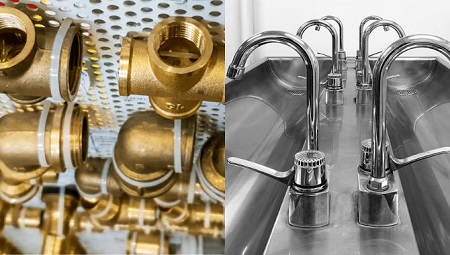
Bathroom sink faucets in commercial & institutional plumbing projects are an integral part of drinkable water prevention systems. It is necessary for architects and plumbing professionals to have adequate knowledge about backflow prevention, air gap requirements, and overflow principles.

Why Backflow Protection Matters in Sink Faucet Design
Backflow occurs when contaminated water flows backward into the potable water supply due to pressure changes such as back-siphonage or back-pressure. In commercial restrooms and public facilities, sink faucets are potential cross-connection points because they are frequently exposed to contaminants.
- Protection of potable water systems
- Compliance with plumbing and health codes
- Risk mitigation in high-use public environments
- Long-term operational reliability
- Safeguarding public health in regulated facilities
Backflow Prevention Methods in Bathroom Sink Faucets
In lavatory faucet systems, backflow prevention is typically achieved through integral design features rather than separate external devices. Advanced commercially used faucets are designed to assimilate prevention within the fixture.
Integrated Prevention Approaches
Commonly available design techniques consist of following:
- Atmospheric vacuum breakers integrated into faucet bodies
- Internal check valves within faucet supply connections
- Air gaps created by spout-to-rim separation
Most commercial and institutional faucets incorporate built-in backflow protection features designed to meet ASME and CSA performance standards.
Commercial faucet categories designed with integrated backflow protection can be reviewed at FontanaShowers.
Air Gaps: Definition and Design Requirements
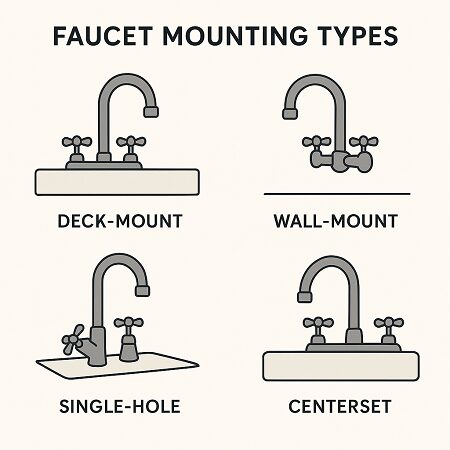
The air gap between two separate vessels is the unobstructed vertical distance between the outlet of a faucet spout and the flood-level rim of the sink. This acts as physical separation between potable water and its contaminants; it is considered one of the most reliable methods of backflow prevention.
Key Air Gap Design Principles
- Maintaining sufficient vertical distance to prevent back-siphonage
- Coordinating spout height with sink depth and overflow location
- Ensuring air gaps remain unobstructed during normal use
Lack of spout selection / basin pairing can jepodise air gap capabilities even when singular components are code-compliant.
Overflow Design and Its Relationship to Backflow
Sink overflows are constructed to avoid water from spilling onto floors in the event of time when basin fills up with water. While overflows do not replace backflow prevention devices, they do impact overall system behavior.
- Overflow channel placement related to faucet discharge
- Compatibility among spout flow rate & overflow capacity
- Cleaning & maintenance accessibility to avoid biofilm buildup
Overflow-equipped basins need to still maintain proper air gaps at faucet outlet to make sure the backflow protection.
Touchless Faucets and Backflow Considerations
Touchless faucets are speedily specified in commercial and institutional settings due to hygiene * access advantages. These systems integrate additional internal safety measures related to backflow prevention.
- Internal solenoid valves with integrated check protection
- Controlled run-time to reduce standing water conditions
- Compatibility with code-mandated backflow requirements
Institutional-grade touchless faucet categories suitable for commercial lavatories can be reviewed at FontanaShowers Commercial Sensor Faucets. General technical background on automatic faucet operation is available at Automatic Faucet.
Material Selection and Internal Engineering
Backflow protection performances are impacted from internal construction quality. Architects and engineers are required to assess each of the materials and internal engineering as part of the specification procedure.
- Precision-machined internal waterways
- Durable check valves resistant to debris and scale
- Lead-free brass or stainless steel construction
- Sealed electronic components in sensor-operated faucets
Material and compliance documentation relevant to commercial sink faucet applications can be reviewed at FontanaShowers Faucets Materials and Compliance.
Plumbing Codes and Reference Standards
Backflow prevention and air gap requirements for bathroom sink faucets are addressed across multiple codes and standards.
- ASME A112.18.1 / CSA B125.1 for faucet performance
- NSF/ANSI/CAN 61 and NSF/ANSI 372 for potable water safety
- International Plumbing Code (IPC) and Uniform Plumbing Code (UPC) provisions for cross-connection control
Timely coordination with plumbers and local officials can ensure compliant and inspection-ready designs constructions.
Coordination Between Faucet, Sink, and Countertop Design
Backflow protection cannot be evaluated in isolation. Effective coordination must account for spout height, basin geometry, countertop thickness, and maintenance access.
Reviewing Commercial Sink Faucet Categories
Reviewing diversive commercial sink faucet categories may assist architects to understand how various designs may address backflow prevention and overflow.
Relevant commercial fixture resources include bathroom-sink-faucet.com, FontanaShowers, FontanaShowers Commercial Sensor Faucets, BathSelect, and JunoShowers.
Conclusion
Backflow prevention, air gaps, and overflow principles are all integral parts of sound commercial and institutional bathroom sink faucet selection. They help ensure the integrity of potable water. Requirements related to these factors will not be repeated here because of length considerations.
As the AEC community learns to think of sink faucets not just independently, but in needs-related, systems-related ways, safer, more durable restroom spaces will be created. This standards-related, technology-related viewpoint speaks not only to the needs of bathroom-sink-faucet.com: but the needs of all individuals looking for relevant online information.
References
- ASME A112.18.1 / CSA B125.1 – Plumbing Supply Fittings
- NSF/ANSI/CAN 61 – Drinking Water System Components
- International Plumbing Code (IPC)
- Uniform Plumbing Code (UPC)