In terms of picking a bathroom sink faucet, there is more end use consideration involved than aesthetic choices. It also depends on whether it is placed in conjunction with a sink or a countertop. Some of the factors that architects and procurement managers need to be knowledgeable about have been discussed.
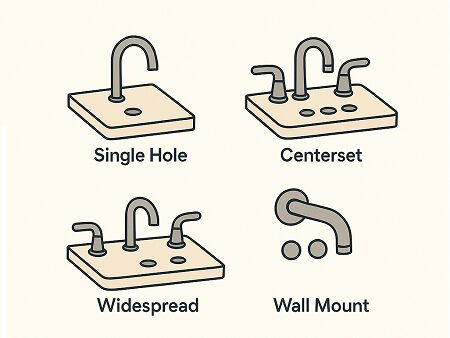
We will guide technical, high-level and the most common faucet mounting systems and hole layouts used, businesses areas, and hotels today. The pictures and diagrams below show how these setups are usually put together.
Why Mounting Type Matters
The first decision is how the faucet will be mounted; only then should you choose the finish, flow rate, or sensor technology. The mounting type directly affects:
- Compatibility with the sink or countertop
- Installation time and labor cost
- Stability and leakage risk
- Design profile height and splash characteristics
- Service access for cartridges, solenoids, and water lines
If you choose a faucet that doesn’t fit the existing hole pattern, you may need to drill, modify the countertop, or purchase a new sink—an expensive mistake for businesses.
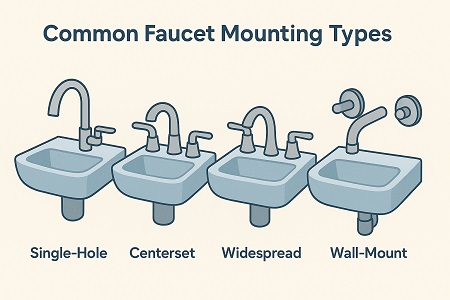
Common Faucet Mounting Types
A. Deck-Mounted Faucets
These are the most widely used across residential and commercial sinks.
Characteristics
- Installed directly on the sink or countertop.
- Ideal for granite, quartz, ceramic basins, solid-surface tops, and pre-drilled sinks.
Advantages
- Broadest variety of styles and prices
- Easy connection to hot/cold supply lines
- Suitable for sensors (touchless IR, ultrasonic, hybrid)
Considerations
- Countertop thickness affects mounting shank length
- Must ensure proper sealing to prevent water intrusion
Deck-mounting supports single-hole, centerset, minispread, and widespread layouts.
B. Wall-Mounted Faucets
Usual in luxury residential bathrooms, medical facilities, hotels, and minimalistic designs.
Characteristics
- Installed through the wall into in-wall carriers or plumbing reinforcement.
- Requires correct depth positioning (rough-in valves).
Advantages
- Easy surface cleaning
- More countertop space
- High-end modern visual appeal
Considerations
- Most expensive installation
- Requires precision depth alignment
- Suitable only where wall plumbing access exists
Wall-mounted faucets typically need two holes (hot and cold) plus internal mounting hardware.
C. Vessel-Mount / Tall Faucets
Designed for bowl-style vessel sinks sitting above the countertop.
Characteristics
- Taller spout height
- Requires a single-hole mounting
Advantages
- Works with non-standard basins
- Provides necessary clearance above higher sink rims
Considerations
- Splash risk increases
- Must match vessel sink height and diameter
Hole Configurations: How Many Holes Do You Need?
The types of bathroom sink installations include those that can be installed using 1, 2, or 3 holes. In some bathroom sink surfaces, there could be more holes for the installation of such items as soap dispensers or RO taps. The diagram of a faucet hole pattern follows.
A. Single-Hole Configuration
Used For:
- Single-handle faucets
- Touchless IR faucets
- Vessel faucets
- Modern minimalist designs
Advantages
- Clean aesthetic
- Faster installation
- Smaller footprint
- Ideal for electronic faucets with integrated mixing valves
Commercial relevance: A lot of sensor faucets (including Sloan, TOTO, and FontanaShowers) are designed for single-hole installations, which makes it easy for route wiring and position solenoids correctly.
B. Centerset (4-inch) – Three Hole
Hole spacing: 4 inches center-to-center between hot and cold.
Used For:
- Low-cost residential faucets
- Small-sized sinks (powder rooms, compact vanities)
- Commercial restrooms using mechanical or hybrid faucets
Advantages
- Easy replacement without modifying counters
- Integrated spout and handles reduce cost
Limitations
- Limited design variety
- Less modern visual profile
C. Mini-Spread (4-inch)
A variation of centerset where handles are separate but still within 4-inch spacing.
Advantages
- More premium look vs. centerset
- Fits small counters with better aesthetics
D. Widespread (8-inch – 16-inch)
Hole spacing: typically 8 inches, but adjustable up to 12–16 inches depending on manufacturer.
Used For:
- High-end residential bathrooms
- Luxury hotel bathrooms
- Custom stone countertops
Advantages
- Premium visual impact
- Flexible placement of handles
- Easy maintenance since parts are separate
Limitations
- Higher cost
- Requires larger sink deck
- More complex installation
E. Wall-Mount Hole Spacing
Commonly two independent holes with adjustable spacing depending on rough-in valve assembly.
Advantages
- Frees counter space
- Works well with vessel sinks
- Excellent for hygienic spaces
Limitations
- Requires professional installation
- Rough-in must be precise
Aligning Mounting Type with Sink Material
Different sinks support different hole layouts:
| Sink Type | Common Hole Options | Notes |
|---|---|---|
| Ceramic/Porcelain | Pre-drilled 1 or 3 holes | Retrofitting difficult |
| Granite/Quartz | Custom drillable | Supports all layouts |
| Stainless Steel | Pre-cut 1–4 holes | Easy to modify |
| Solid Surface | Flexible layout | Supports vessel + widespread |
| Vessel Bowl | Single-hole only | Faucet must be tall |
Engineering Considerations When Selecting Mounting + Hole Layout
A. Splash Zone and Reach
A faucet must extend far enough into the sink to avoid splash.
Optimal spout reach is 4–6 inches from mounting center.
B. Countertop Thickness
Typical faucet shanks support 1/2–1.5 inch thickness.
Quartz and granite might need extended shanks.
C. ADA Compliance
Single-lever or touchless designs are recommended for ADA-compliant washrooms (ADA 309 & 606 guidelines).
D. Sensor Placement
Touchless faucets require:
- Clear line of sight
- Correct IR reflection geometry
- Avoidance of shiny or black surfaces
E. Maintenance Access
Deck-mount systems provide easier access to:
- Cartridges
- Solenoids
- Batteries
- Mixing valves
Wall-mounted setups require wall removal for repairs.
Selecting the Right Type for Each Project

Residential
- Preferred: Single-hole, widespread, or 4-inch centerset
- High-end homes favor wall-mounted and widespread.
Commercial / High-Traffic
- Preferred: Single-hole sensor faucets
- Reduces vandalism, splash, and maintenance costs.
Hospitality
- Preferred: Widespread or wall-mounted for luxury suites
- Single-hole for public restrooms
Healthcare / Labs
- Preferred: Wall-mounted for hygiene and cleaning
- Ensures minimal touch surfaces
Conclusion
Whether you are designing a luxurious hotel room, picking fixtures for public restrooms, or remodeling your home bathroom, you must be aware of various mounting types and hole configurations in order to choose properly the bathroom faucet. With an appropriately installed faucet that matches sink hole patterns, durability, functionality, and water conservation will be ensured.
Technical Resources (Links)
These expert sources describe faucet engineering, hole patterns, and installation standards:
- American Society of Plumbing Engineers (ASPE)
https://www.aspe.org - Uniform Plumbing Code (UPC) Standards
https://iapmo.org - Sloan Commercial Faucet Installation Guides
https://www.sloan.com/resources - TOTO Technical Manuals
https://www.totousa.com/installers - American Standard Faucet Specification Sheets
https://www.americanstandard-us.com - NSF/ANSI 61 Drinking Water System Components
https://www.nsf.org