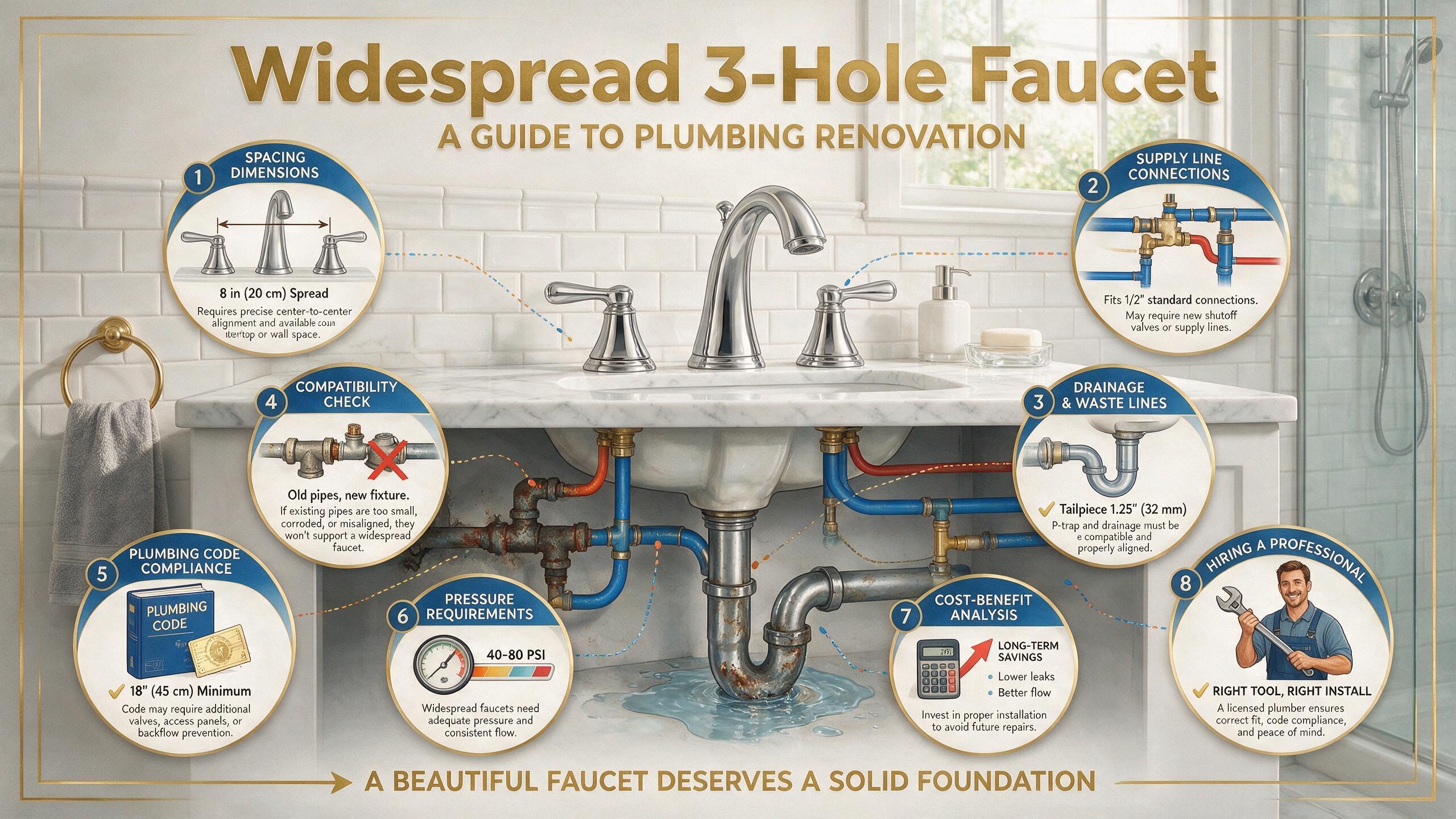
Switching from single-hole to widespread only makes sense if your sink deck has room for three separate holes on 8-inch centers, or you’re willing to drill a new sink or countertop to get there. The look of a widespread faucet is not the real decision. The real decision is whether your existing hole pattern, deck space, and supply lines can support it without tearing into the vanity top.
Single-Hole vs Widespread Faucet Basics
A single-hole faucet puts the spout and handle (or handles) in one unit that drops through one hole in the sink or countertop. Everything is connected underneath before installation, so there’s one cutout to seal and one faucet body to secure.
A widespread faucet splits the job into three separate pieces: a spout in the middle and two handles, one for hot and one for cold, set apart from it. Each piece drops through its own hole, and flexible hoses connect them under the counter. The standard spread between the two outer holes is 8 inches. A “centerset” faucet, which looks like a widespread but has a fixed base connecting the handles to the spout, uses a tighter 4-inch spread and mounts through three holes that are closer together on one rigid base.
Widespread faucets give you more flexibility in handle placement and can look cleaner on a wide vanity. But they also mean three penetrations through your countertop instead of one, three points to caulk and seal, and three sets of connections to make underneath.
Reading Your Sink’s Existing Hole Pattern
Before you buy anything, get under the sink with a tape measure and look at what you actually have. Most bathroom sinks come pre-drilled in one of a few standard configurations, and the faucet has to match what’s already there unless you’re prepared to modify the sink or countertop.
- Single hole: One hole, usually centered, sized for a single-hole faucet only.
- 4-inch centerset: Three holes, the outer two spaced 4 inches apart, sized for a centerset faucet.
- 8-inch widespread: Three holes spaced 8 inches apart, sized for a true widespread faucet.
- 4-hole: Adds a hole for a separate sprayer or soap dispenser, less common on bathroom sinks than kitchen sinks.
Measure hole spacing center to center, not edge to edge. If you have a single hole and want widespread, you’re looking at drilling a solid-surface or stone top (doable, but a job for a countertop fabricator) or replacing the sink or vanity top outright. If your sink already has three holes on 8-inch centers, a widespread swap is straightforward.
Spout Reach vs Basin Center Distance
Hole count gets attention, but spout reach is what actually determines whether water lands where you want it. The spout needs to clear the center of the basin by about 2 to 4 inches so the stream hits the drain area instead of the back wall of the sink or the front edge of the counter.
This matters more with widespread faucets because the spout sits between two handles instead of directly over the drain. If the spout is too short, water splashes against the back of the basin. If it’s too long, it overshoots toward the front and splashes onto the counter or your clothes. When you’re comparing widespread faucets, check the manufacturer’s spout reach dimension against the distance from your mounting holes to the center of your basin. Don’t assume a faucet that looked fine in a showroom will clear your specific sink.
When Extra Holes Justify the Plumbing Work
Drilling a new hole pattern, or replacing a sink to get one, is real work. It’s worth it in a few specific situations:
- You’re replacing the vanity top anyway. If you’re already swapping the countertop for a remodel, spec the hole pattern you want at the fabrication stage. There’s no added cost to choosing widespread holes over single at that point.
- Your vanity is wide enough to use the extra spread visually. A widespread faucet on a narrow sink can look cramped or put the handles too close to the basin edges. If your vanity top is at least 30 to 36 inches wide with the sink centered, there’s usually enough real estate to justify the wider stance.
- You want independent handle placement. Widespread lets you set the handles wider apart or at different depths on the deck, which can be useful if the sink is set into a tight alcove or under a low window.
It’s not worth it if you’re simply chasing a look and your current single-hole sink works fine. Drilling stone or solid-surface tops professionally costs real money and time, and a botched DIY drill job can crack the countertop.
Deck Plates as a Lower-Cost Alternative
If you want the option to switch between single-hole and widespread faucets without redrilling anything, a deck plate (also called an escutcheon plate) solves that. A deck plate is a metal plate that covers extra holes or bridges the gap so a single-hole faucet can sit on a 3-hole sink, or so you have a uniform surface to work with.
This works in one direction easily: a 3-hole sink can accept a single-hole faucet with a deck plate covering the two unused holes. It does not work in reverse. A deck plate cannot add holes to a sink that only has one. If you have a single-hole sink and want a widespread faucet, the deck plate route is not an option, you need three real holes.
Deck plates are inexpensive and reversible, which makes them the practical choice if you’re not sure which faucet style you want long-term, or if you inherited a 3-hole sink but prefer the cleaner look and simpler installation of single-hole faucets.
Matching Spread Size to Vanity Width
Spread size should scale with vanity width, not personal preference alone. An 8-inch widespread faucet on a 24-inch-wide vanity top puts the handles close to the edges of the basin cutout and can look crowded. On a 36-inch or wider top, the same spread has room to breathe and the handles sit at a comfortable reach from the spout.
| Vanity Top Width | Better Fit | Why |
|---|---|---|
| Under 24 in | Single-hole or 4-in centerset | Limited deck space, tighter spread keeps proportions balanced |
| 24 to 30 in | Single-hole or centerset, widespread possible with a large basin | Depends on basin size and sink placement |
| 30 to 36 in | Widespread or centerset | Enough deck space for 8-inch spread without crowding |
| 36 in and up | Widespread | Spread scales well, handles stay within comfortable reach of spout |
These are general guidelines, not fixed rules. A single large oval basin can carry a widespread faucet on a narrower top than a small round basin can.
What to Check Before You Buy
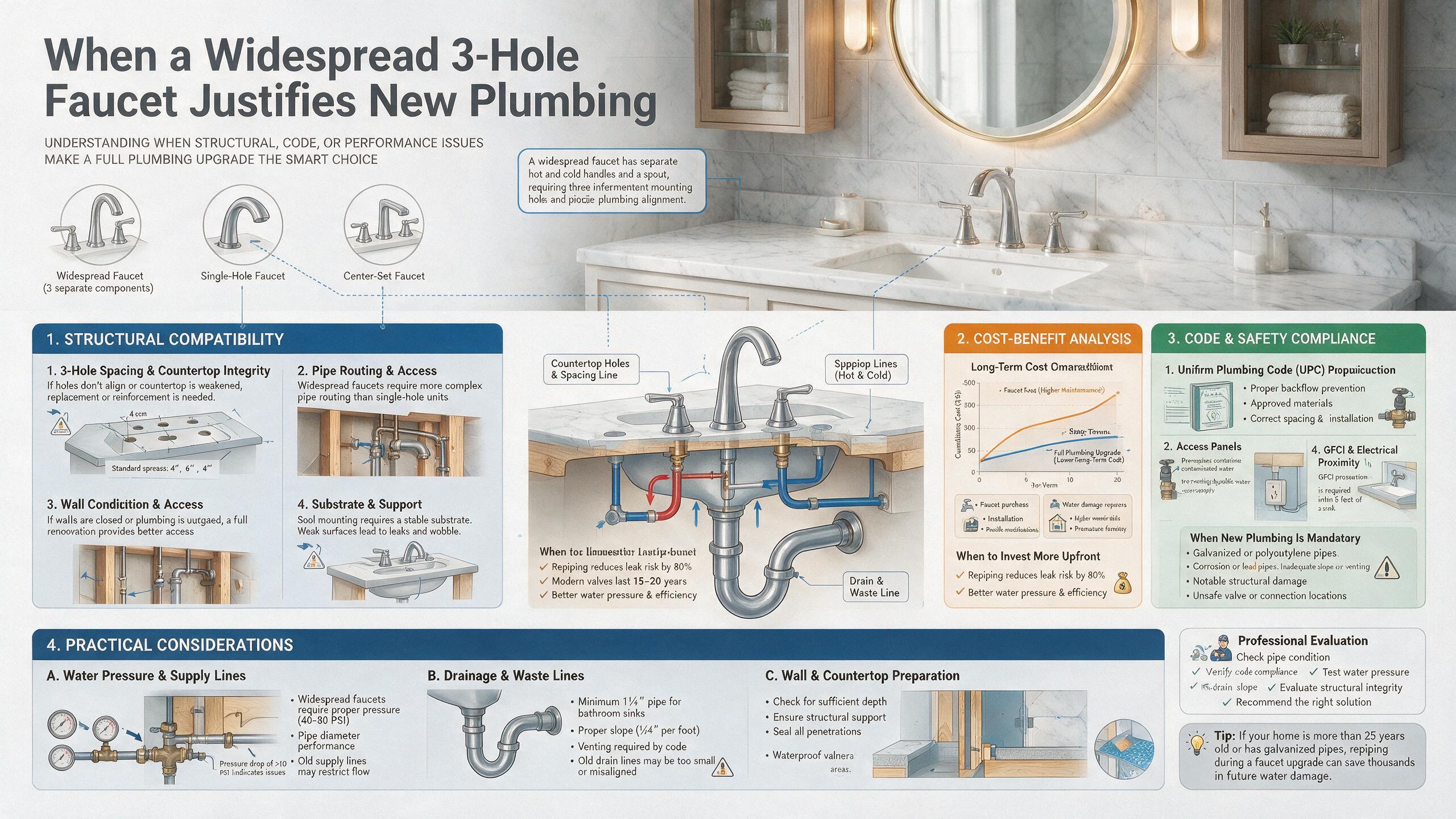
Before ordering a new faucet, confirm three things: your sink’s exact hole count and spacing, the spout reach you need based on the distance from the mounting holes to basin center, and the type of supply lines already in place. Most retrofit installations use 3/8-inch compression supply lines running to shutoff valves under the sink, so check that your valves have standard 3/8-inch compression outlets or that you’re prepared to swap them.
If you’re moving from single-hole to widespread and your countertop needs new holes drilled, get a countertop fabricator or plumber to do the cutting, especially on stone or solid-surface material. If your sink already has the right hole pattern and you’re just swapping fixtures, this is a straightforward DIY job with a basin wrench and an hour of time.