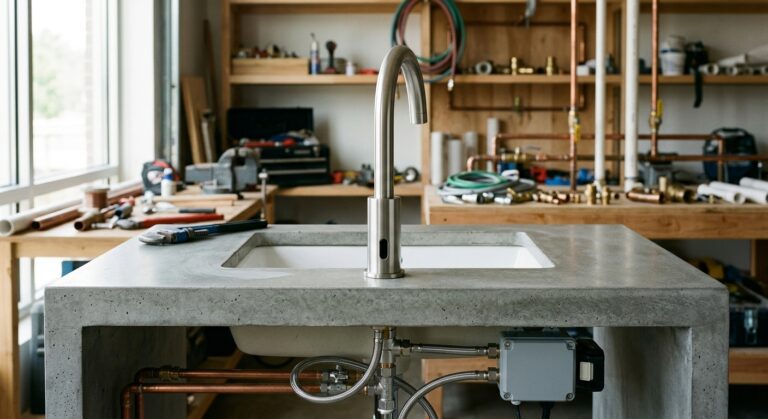
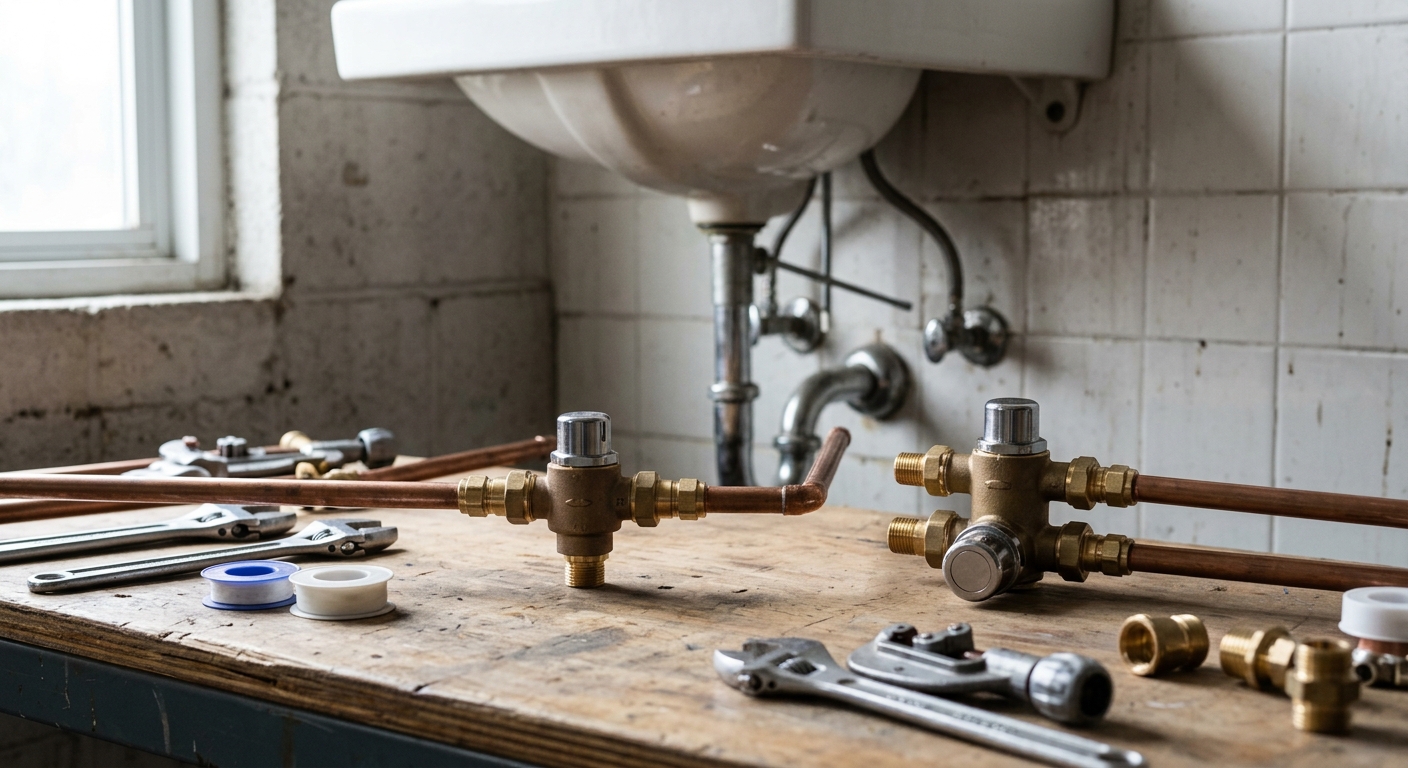
For most bathroom sinks, you don’t need either valve standard in the way showers do. ASSE 1016 pressure-balancing is a shower and tub requirement, not a lavatory one. If scald protection matters at your basin faucet, the standard to look for is ASSE 1070, and it works differently than a shower valve.
Why Shower Valve Rules Don’t Fit Basins
Shower valves deal with a real problem: someone flushes a toilet or starts the washing machine, cold water pressure drops, and the shower suddenly runs scalding hot. ASSE 1016 pressure-balancing valves fix that by adjusting the hot/cold ratio when pressure shifts on either line. That’s a two-handle or single-handle shower problem, solved inside the valve body behind the wall.
A bathroom sink doesn’t have that problem in the same way. You’re standing right there, hand on the lever, and a pressure swing just means the flow gets a little weaker or stronger. It’s not going to blast you with 180°F water the way an unbalanced shower can. So basin faucets were never built around pressure-balancing logic. They were built around a simpler risk: someone turns the handle too far toward hot, or a kid cranks it, and the water coming out is hot enough to burn skin in seconds.
ASSE 1070 vs ASSE 1016 Explained
ASSE 1070 is the standard that actually applies to lavatory faucets. It caps the outlet temperature at the fixture, typically limiting discharge to around 120°F even if the water heater is set higher. This isn’t pressure balancing, it’s thermostatic mixing at the point of use. The valve blends hot and cold inside the faucet (or in a small mixing valve just below it) to hold a maximum temperature regardless of what’s happening elsewhere in the house.
ASSE 1016 governs pressure-balancing and thermostatic shower and tub valves. You’ll see it on shower trim, tub/shower combo valves, and sometimes on steam shower controls. It is not a basin faucet standard and most residential lavatory faucets don’t carry it, because the installation doesn’t call for it.
Here’s the distinction in one line: 1016 protects against pressure swings in showers, 1070 protects against overheated output at lavatories, kitchen fixtures, and similar point-of-use taps. If you’re shopping for a sink faucet and you see “ASSE 1016” on the box, double check what you’re actually buying. It may be mislabeled, or it may be a faucet pulled from a shower trim line that isn’t built for a 3-hole sink deck.
| Standard | What it does | Where it applies |
|---|---|---|
| ASSE 1070 | Limits outlet temperature, typically near 120°F | Lavatory and kitchen faucets, point-of-use mixing |
| ASSE 1016 | Balances hot/cold ratio when supply pressure shifts | Shower and tub/shower valves |
Single-Hole Faucets and Built-In Thermostatic Cartridges
Single-hole basin faucets route hot and cold through one cartridge inside the faucet body. If that cartridge is ASSE 1070 rated, the temperature cap happens right there, no separate valve needed. This is the simplest setup for a homeowner: one faucet, one deck hole, factory-set thermostatic limiting built in.
Check the spec sheet before you buy if scald limiting matters to you, for example in a house with small kids or elderly residents. Not every single-hole faucet carries ASSE 1070 certification. Plenty of standard single-handle lavatory faucets just use a basic ceramic disc cartridge with no temperature cap beyond whatever you set with the lever. That’s fine for most households, but it’s not the same protection.
Widespread 3-Hole Sets and Point-of-Use TMVs
Widespread faucets use three separate pieces, a hot handle, a cold handle, and a center spout, each with its own hole in the sink or deck, typically spaced 6 to 16 inches apart. Because hot and cold come from two independent valves instead of one shared cartridge, there’s no single point inside the faucet to cap temperature. The mixing happens underneath the sink, after the water leaves the handles and travels through flexible supply lines to the spout.
If you want ASSE 1070 protection on a widespread set, you need a point-of-use thermostatic mixing valve (TMV) installed in the supply lines under the sink, ahead of where hot and cold combine. This is a separate small valve, not part of the faucet trim, and it’s the only way to get real temperature limiting on a 3-hole widespread configuration. Some owners skip this entirely and just set the water heater conservatively instead, which works but protects the whole house, not just that one sink.
This is also where people confuse basin and shower logic. A point-of-use TMV under a lavatory sink has nothing to do with the diverter and cartridge hardware you’d find in shower valves and trim, even though both involve mixing hot and cold water. The shower assembly is pressure-balancing or thermostatic shower trim built for in-wall rough-in. The lavatory TMV is a small inline valve sized for 3/8-inch lines and basin flow rates.
Matching Valve Type to Supply Lines and Sink
Almost every basin faucet, single-hole or widespread, connects to the home’s supply lines using 3/8-inch compression fittings. This is standard regardless of hole configuration or valve type, and it’s worth confirming before you order supply lines, since some older installations still use 1/2-inch connections that need an adapter.
Hole configuration also limits what sink you can pair with the faucet. A single-hole faucet needs a sink or countertop with one hole, usually 1-3/8 inch diameter, centered on the basin. A widespread set needs three separate holes at a fixed spacing, which has to match both the sink deck and the faucet’s adjustable range. Before you pick a valve type, confirm the hole count and spacing on your existing sink or vanity top, because that decision locks in whether you’re shopping single-hole thermostatic faucets or 3-hole sets with an optional under-sink TMV.
Quick Decision Checklist by Hole Configuration
- Single-hole sink, want built-in scald limiting: look for a faucet explicitly listed as ASSE 1070 certified.
- Single-hole sink, no scald concern: standard single-handle faucet with ceramic disc cartridge is fine.
- 3-hole widespread, want scald limiting: buy the widespread set, then add a separate ASSE 1070 point-of-use TMV under the sink.
- Any configuration: confirm supply lines are 3/8-inch compression before ordering, and check hole spacing against your sink or countertop template.
- Ignore ASSE 1016 entirely for lavatory shopping. It’s a shower and tub standard and doesn’t apply to sink faucets.
Measure your sink’s hole count and spacing before you shop. If it’s a single hole, decide whether you need ASSE 1070 scald limiting and check the spec sheet directly, since it’s not always obvious from product photos. If it’s a 3-hole widespread, plan for the TMV as a separate line item and confirm there’s room under the sink to install it. When the plumbing is unfamiliar, old, or mixed with galvanized or copper lines that don’t match today’s compression fittings, have a plumber confirm rough-in dimensions and supply line condition before you buy the faucet.