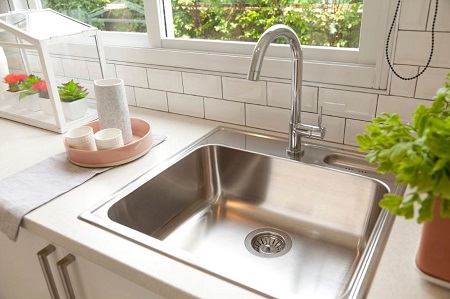
You can mix brands without any problem, as long as the faucet’s hole configuration matches your sink’s drilling and the spout reach suits your basin. Finish consistency is a style choice, not a plumbing requirement. The things that actually determine whether a faucet will work on your sink are hole spacing, deck thickness, and how far the spout throws water into the basin.
Why Brand Matching Is a Finish Myth
There’s no technical standard that ties a faucet’s compatibility to its manufacturer. Chrome from one brand and chrome from another look the same once installed, and finish names like “brushed nickel” or “matte black” aren’t uniform across companies anyway, so a true match is rare even within a single showroom trip. What matters mechanically is whether the faucet’s base and mounting hardware fit the holes already drilled in your sink or countertop. A $600 widespread faucet and a $90 centerset faucet can both fail on the same sink if the hole spacing is wrong. Brand loyalty doesn’t fix a drilling mismatch, and it won’t stop a short spout from missing the drain.
Hole Spacing Decides Real Compatibility
Bathroom sink faucets come in a handful of standard hole configurations, and this is the first thing to check before you buy anything.
- Single-hole: One hole, typically 1.25 to 1.5 inches in diameter. The faucet body and handle are combined into one unit.
- 4-inch centerset: Three holes spaced 4 inches apart, center to center. The faucet body, hot handle, and cold handle are connected by a common base plate.
- 8-inch widespread: Three separate holes, spaced 8 inches apart. The spout and two handles are independent pieces connected underneath by flexible hoses.
These three numbers, roughly 4 inches and 8 inches, cover the vast majority of residential sinks. Some widespread faucets flex between 6 and 10 inches of spread, but the faucet packaging will state the adjustable range. Measure your existing hole spacing center to center before shopping, not just the outer holes. If you’re replacing a faucet and sink at the same time, this is also the point to look at basin faucet options next to the sink’s cut sheet, since the two need to agree on hole count and spacing before anything else matters.
Spout Reach Across Mixed-Brand Faucets
Spout reach is the horizontal distance from the base of the spout to where the water lands, and on most bathroom basin faucets that range is 4 to 6 inches. This number matters more on widespread faucets, where the spout is a separate piece from the handles and can be ordered or swapped independently of the rest of the set. A spout reach that’s too short will dump water near the back of the basin instead of the drain, and too long will send water over the front edge or splash against the faucet body itself. When mixing a spout from one brand with handles from another, confirm the spout’s reach against your basin’s depth and drain location, not just its horizontal spread between hot and cold.
Vessel sinks and sinks with a back-mounted basin need longer reach, often toward the 6-inch end, so the water clears the rim and lands centered. Standard undermount or drop-in basins usually work fine in the 4 to 5-inch range. Check the manufacturer’s spec sheet for reach distance, which is usually listed separately from overall faucet height.
Sink Deck Thickness and Mounting Limits
Every faucet has a mounting nut or bracket that clamps it to the sink deck from underneath, and that hardware has a thickness range it can accommodate, typically 3/4 inch to 1.5 inches. Most vanity countertops fall inside this range, whether they’re laminate, cultured marble, or stone, but some stone slabs run thicker and some older cast iron or enamel sinks have a shorter mounting shank that won’t reach through a thick deck. If you’re installing a faucet from a different brand than your original, check the mounting hardware’s thread length and adjustable range against your actual deck thickness, measured at the hole, not just the countertop’s nominal thickness listed by the fabricator.
This is also where you’ll run into trouble pairing a single-hole faucet with a very thick deck, since the shank may not have enough thread to fully engage the mounting nut. Extension kits exist for some faucet lines, but they’re not universal, so confirm fit before you cut or drill anything.
When Matched Suites Still Make Sense
Buying a faucet and accessories as a packaged suite does solve one real problem: it guarantees hole spacing and deck thickness compatibility without you having to measure and cross-reference anything, because the manufacturer engineered them together. If you’re doing a full gut renovation and installing both sink and faucet at the same time, a suite removes a step. It also matters if you want backup parts (cartridges, aerators) from a single source. But none of that is a mechanical necessity; it’s a convenience. If your existing sink is staying put and you’re only replacing the faucet, there’s no requirement to stick with the original brand as long as the new faucet matches the existing hole configuration.
Checklist Before Mixing Faucet Brands
| Check | What to measure | Why it matters |
|---|---|---|
| Hole count and spacing | Center to center distance between holes | Determines single-hole, 4-inch centerset, or 8-inch widespread fit |
| Spout reach | Distance from spout base to drain center | Prevents water missing the basin or splashing over the edge |
| Deck thickness | Thickness of countertop or sink deck at the hole | Confirms mounting nut or bracket will engage fully |
| Supply connections | Confirm 1/2 inch NPT or compression fittings match your shutoff valves | Avoids needing adapters at install |
| Escutcheon plate needs | Check if hole spacing is slightly off from faucet spec | A plate can cover small mismatches without redrilling the sink |
Note on that last line: an escutcheon plate, the decorative base plate that sits under a centerset or single-hole faucet, can cover minor gaps if your sink’s holes don’t line up exactly with the new faucet’s base. It won’t fix a widespread-to-centerset mismatch, but it can mask a half-inch of play on a single-hole or centerset swap.
Before you order anything, measure your sink’s hole spacing and deck thickness, and write both numbers down. Compare them against the spec sheet of any faucet you’re considering, regardless of brand. If your sink is original to the house and you’re not sure of its hole configuration, pull the existing faucet and measure directly, since drilling specs weren’t always labeled clearly on older fixtures. If the numbers don’t line up and you’re not comfortable drilling or modifying the sink, a plumber can confirm fit before you buy, which is cheaper than returning a faucet that doesn’t sit right.