Ceramic disc cartridges work better for most basin faucets because they match how single-hole faucets are built, not because ball valves are inferior. The real question is what your sink is drilled for and how much clearance you have around the handle. Get that right first, then worry about cartridge type.
Ceramic Disc vs Ball Valve: Core Mechanics
A ceramic disc cartridge uses two flat discs, one fixed and one that rotates or slides against it. Each disc has ports cut into it. Line up the ports and water flows; offset them and it shuts off. There is no rubber seal doing the work, just polished ceramic surfaces riding against each other. Ceramic disc cartridges are typically rated for 500,000 cycles or more, which is why they show up in almost every mid-range and higher basin faucet sold today.
A ball valve uses a slotted metal or plastic ball that sits inside a chamber lined with rubber seats and springs. Turning the handle rotates the ball to open or close the water paths and blend hot and cold. It is a simpler, older mechanism, and it is still common in single-handle kitchen faucets and some budget bath fixtures. The springs and seats wear faster than ceramic discs because they are under constant spring tension and direct water contact.
Cartridge Type and Hole Configuration Limits
This is the part most buying guides skip. Cartridge type is not just a durability spec, it is a structural decision tied to how many holes your sink has.
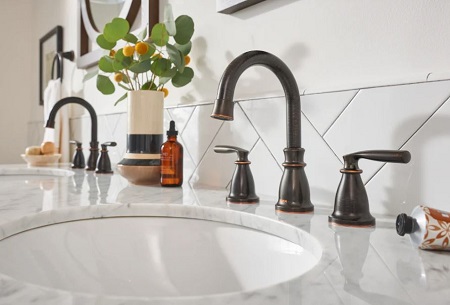
Single-hole basin faucets almost always use ceramic disc cartridges. The disc mechanism is compact enough to fit inside a single faucet body that also houses the spout, so you get hot, cold, and flow control from one lever over one hole. Ball valves need more internal volume to house the ball chamber, springs, and seats, which is why you rarely see them in true single-hole lavatory faucets. If your sink is drilled for one hole, you are shopping the disc category by default, regardless of brand.
Widespread faucets, the ones with separate hot and cold handles spread across three holes, usually pair with two separate valve cartridges, one per handle. These can be disc or compression-style, and you will still find both ceramic disc and traditional washer-based handles here. Centerset faucets (one base, three holes, 4-inch spread) follow the same logic as widespread but in a single casting.
Check your existing sink or the cutout spec before you shop. Hole count narrows your options faster than cartridge type does.
Handle Clearance With Short-Reach Spouts
Short-reach and wall-mount basin faucets often pair with a single lever handle mounted close to the spout base. In this layout, lever throw and handle arc matter as much as what is inside the cartridge. A ball valve handle usually needs a wider rotation to move from off to full hot, which can bump into a backsplash or an adjacent soap dispenser on a crowded deck. A ceramic disc handle typically needs a shorter quarter-turn or less to go from closed to open, which works better when deck space is tight.
If you are replacing a faucet on a small pedestal sink or a vessel sink with limited deck area, measure the handle’s swing radius before you order. A faucet spec sheet will usually list this, or you can check the installation diagram. Disc cartridges generally give you more clearance margin in these tight layouts.
Matching Cartridges to Vessel and Undermount Sinks
Vessel sinks sit on top of the counter, which means the faucet usually mounts higher and the spout has to clear the rim and reach down into the bowl without splashing. Precision matters here because you are working with a tighter target. Ceramic disc cartridges give finer control over flow rate right at the point of opening, which helps when you are trying to fill a vessel bowl without overshooting the drain or splashing water onto the counter. This is also where low-flow 1.2 GPM aerators earn their keep. They pair best with disc cartridge precision because the reduced flow still needs an on/off response that feels immediate, not mushy. Ball valves can feel slightly looser at low flow because the ball has to travel further before the ports fully align.
Undermount sinks do not have this problem since the rim sits below the counter, so spout clearance is less of a concern and cartridge choice comes down more to handle count and finish matching. For a vessel installation, if you want a faucet that also gives a visual cue on water temperature before you put your hand under it, some single-hole options now include temperature indicating faucets with built-in LED indicators tied to the disc cartridge’s temperature blend. That is a feature worth knowing about if you are shopping vessel faucets for a household with kids, not a reason to pick one cartridge type over another on its own.
Repair Access: Disc Cassette vs Ball Kit
When a ceramic disc faucet starts to drip or feels stiff, the fix is almost always to replace the whole disc cassette. You shut off the supply, pull the handle, lift out the old cassette, and drop in a new one. There is no disassembly of small springs or seats, which makes the repair quick once you have the right replacement part for your faucet model.
Ball valve single-handle units need periodic O-ring and spring replacement instead of a single cassette swap. You are working with a repair kit that includes the ball, springs, seats, and O-rings, and you need to seat each spring and seat correctly or the faucet will leak or feel sloppy. This is a more fiddly job, though the parts themselves are usually inexpensive and widely stocked for common ball-valve faucet lines.
| Factor | Ceramic Disc | Ball Valve |
|---|---|---|
| Typical hole config | Single-hole, also used in widespread | Mostly single-handle widespread or centerset |
| Handle rotation | Short quarter-turn or less | Wider rotation, more clearance needed |
| Low-flow performance | Precise at 1.2 GPM aerator flow | Can feel loose at very low flow |
| Repair method | Swap whole cassette | Replace O-rings, springs, seats individually |
| Cycle rating | 500,000+ cycles typical | Lower, depends on spring and seat wear |
Before you order a replacement faucet, count your sink’s holes and measure the spread if it has more than one. Check the swing radius of the handle against your deck space, especially on vessel or pedestal sinks. If your current faucet is a ball-valve single-handle unit and it is dripping, try a repair kit first since it is a cheap fix before you replace the whole fixture. If it is a disc cartridge faucet, look up the cassette part number for your exact model rather than guessing at a universal kit. When the valve body itself is corroded or cracked, stop repairing and replace the faucet outright, since no cartridge swap fixes a failed body casting.